
The contemporary world offers us a multitude of options to choose from: newspapers to read, movies to watch, languages to learn, foods to eat…
Therefore, distinguishing between good options and bad options has become a commonly felt need.
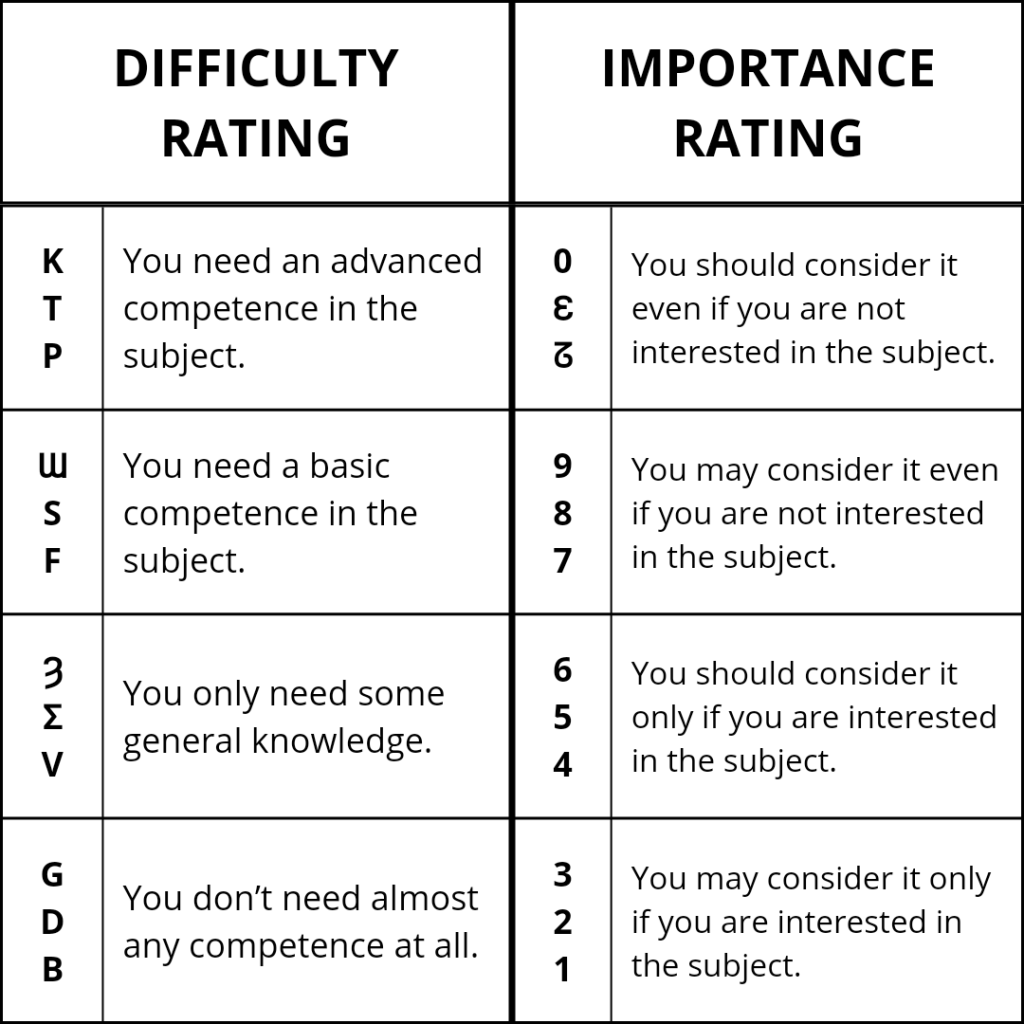
The system that we propose here assigns two different numbers to any option that we want to evaluate (be it a book, a restaurant or anything else): the ordinal number* stands for its difficulty (how much you have to be prepared in order to properly appreciate it) and the cardinal number* stands for its importance (how much it is likely worth your attention).
* Remember: we have a dozenal system, so after 9 there is not 10, but ᘔ, Ɛ and 10. Human ordinal numbers are not I, II, III, IV…, but B, D, G, V, Ʃ, Ȝ, F, S, Ɯ, P, T, K.
Difficulty is divided into four categories:
• B, D and G: you don’t need almost any preparation at all (e.g. a children’s book, a food stall, a blockbuster);
• V, Ʃ and Ȝ: you don’t need almost any preparation about the subject, but some general knowledge (e.g. a newspaper, a family restaurant, a light movie);
• F, S and Ɯ: you need a basic preparation about the subject (e.g. a book for undergraduates, a refined restaurant, a challenging movie);
• P, T and K: you need a good preparation about the subject (e.g. a specialist article, a luxurious restaurant, an art-house movie).
The first number in every category stands for “less difficult”, the second for “of average difficulty”, the third for “more difficult”: for example, a G book is a book for middle schoolers.
Importance too is divided into four categories:
• 1, 2 and 3: if you are interested in the subject, you could take it into consideration (e.g. an interesting Indian history book, Chinese restaurant, Western movie):
• 4, 5 and 6: if you are interested in the subject, you should take it into consideration (e.g. a good Indian history book, Chinese restaurant, Western movie);
• 7, 8 and 9: even if you are not interested in the subject you could take it into consideration (e.g. an interesting book, restaurant, movie);
• ᘔ, Ɛ and 0: even if you are not interested in the subject you should take it into consideration (e.g. a good book, restaurant, movie).
The first number in every category stands for “less important”, the second for “of average importance”, the third for “more important”: for example, a 3 book is very interesting (but not fundamental) if you like the subject.
As you can see, there are no bad ratings: 1 is already a good rating, it means that the option is interesting. The reason is that bad options are not worth judging and it is better to consider them as if they didn’t exist.
Furthermore, a 6 book is not inherently worst than a 7 book: the purpose of our system is only to channel your attention to things that deserves it, but it is up to you to choose once you know them (and to change the ratings, if you are part of our culture).
The main aim of this system is to stimulate reasoned discussions for negotiating together the cultural references of a common global culture, instead of letting popularity and the market decide for us. Otherwise, dominant cultures will keep imposing their references to dominated ones.
A few practical examples (you will find more in our School), whose ratings are by the way open to discussion:
The Divine Comedy: Sᘔ.
S because it is a challenging reading, not for all, but at the same time accessible to anyone who has a basic competence in Italian literature, thanks to the many commentaries available (otherwise it would be a “P” at least).
ᘔ because it is a poem that anyone should know at least by hearsay.
The Ossetian language: 3.
The difficulty of a language depends on the languages you already know, so we are not evaluating it here.
Ossetian is not a language for everyone, so its rating is below 7. In addition, it is not a language that you should feel obliged to learn if you study Iranian languages or the languages of the Caucasus, so its rating is below 4. Nonetheless, it is a beautiful language that gives you access to a noble culture, so it deserves all the attention of those interested in the area.
Bahnhof Wiedikon (a restaurant in Zürich): Ʃ8.
Ʃ because it is a typical family restaurant in the cheap range (relatively to Zürich of course: $20 per person), so it is quite accessible to everyone.
Its food is so good that you could eat there even if you don’t particularly like the Swiss or European cuisines, so its rating is above 6. On the other hand, it is not worth a visit in Zürich just for it, so its rating is below ᘔ. Its rating is 8 because if you are in Zürich you could seriously think about going there.
 Il Vento d'Oriente